
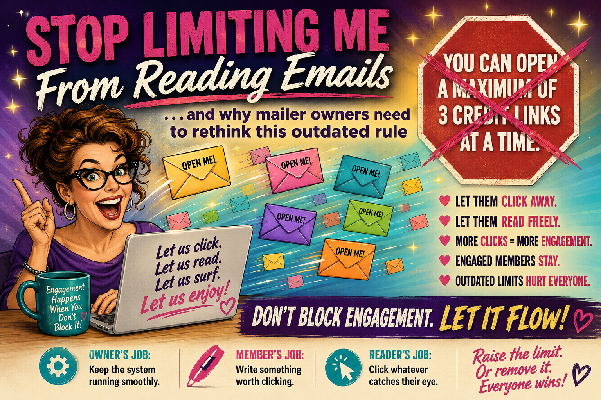
…and why mailer owners need to rethink this outdated rule
If you’ve been around mailers as long as I have (giggle), you’ve seen a lot of strange ideas come and go. But one thing I’ve never understood — not in 2008, not in 2015, not today — is why mailer owners insist on limiting how many emails a member can open at once.
I mean really… why?
On one mailer, I get this message:
“You can open a maximum of 3 credit links at a time.”
Cute. Except I only have 2 open. Not 3. Not even close.
And when that message pops up, you know what happens? I stop clicking. Period. Momentum gone. Interest gone. Bye‑bye engagement.
🌟 The logic just isn’t there
Why would an owner limit people from reading emails? It’s backwards. It’s upside‑down. It’s the opposite of what a mailer is supposed to do.
Owners don’t create the engagement — members do.
It’s the people writing the emails who make them interesting enough to click. It’s their responsibility to grab attention, spark curiosity, and stand out from the crowd.
If an email is boring, limiting clicks won’t magically make it better. If an email is great, limiting clicks just means fewer people get to see it.
🌟 Let them click away
If someone wants to open 5 emails at once, let them. If someone wants to open 10, let them. If someone wants to click through 50 in a row, LET THEM.
That’s literally the point of a mailer.
The owner’s job is to keep the system running smoothly. The member’s job is to write something worth clicking. The reader’s job is to click whatever catches their eye.
Limits don’t help any of those roles.
🌟 The real issue: outdated settings that never got updated
A lot of owners run multiple sites — sometimes dozens. And when you’re juggling that many, little things slip through the cracks:
- Old settings stay in place
- Outdated limits never get reviewed
- Nobody notices… except the people actually clicking
And trust me, when you click as fast as I do, you notice everything.
🌟 A simple fix that helps everyone
Raise the limit. Or remove it entirely.
Let people read the emails. Let them click freely. Let the system breathe a little.
Because when you stop me from reading emails, I stop clicking. And I’m not the only one.
🌟 Final sparkle
Mailer owners: If you want engagement, don’t block it. If you want clicks, don’t limit them. If you want members to stay active, make it easy for them to stay active.
Let us click. Let us read. Let us surf. Let us enjoy the mailer the way it was meant to be used.
Stop limiting me from reading emails — and watch your engagement go up.
Absolutely, great post. I also get frustrated when I can only open 3 at a time. I give up and move onto the next one. I do like the mailers with the automatic timers only and no images or numbers to click. Smooths the marketing process even more but I understand why it is all done and each mailer/platform owner each have their own theory.
Darren, thank you so much for taking the time to comment — that means a lot.
And yes, exactly! That “only open 3 at a time” thing stops the whole flow. Once the system blocks me, I do the same as you… I move on to the next one, and the mailer loses the click.
I’m with you on the smooth, automatic timers too. When a mailer just lets you click and go, everything feels easier, and the marketing works the way it’s supposed to. Every owner has their own theory, but those limits really do hurt engagement.
Appreciate you chiming in — nice to know I’m not the only one feeling it.
Hi Nancy, this limitation has been bugging me for years. If I know it’s like this, I simply won’t join, and you get to know the owners when you’re actively using mailers a lot. But you don’t always get this info before signing up and it’s very frustrating.
My first thought is that the owner wants to try and force upgrades by punishing free members especially when combined with a very small credit per click allocation. I always test sites as a free member, because these are the ones who will be clicking our ads the most and if the environment is bad for them, the site won’t be worth bothering with. If the owner is as tight with upgraded members, well, I have no words for this :-))
Another thing that annoys me is when credits per click are 1. I don’t even know how that happens. How anyone can lack experience to that degree and try and run a mailer is beyond me 🙂
Great post, thank you.
Thank you so much for sharing this — I felt every word. It really is frustrating when you join a mailer only to discover limits that completely break the flow.
And yes, testing as a free member is exactly what I do too, because that’s the group actually clicking our ads. If the environment isn’t good for them, the whole site suffers.
I also agree about the 1-credit-per-click sites. That’s not “tight”—it’s just counterproductive.
Your perspective is spot-on, and I really appreciate you taking the time to share it here.
I think most people limit the number as they want the advertisements to be really seen. When someone clicks and opens 20 mails at the same time, they are not really seeing the pages at all. The advertiser’s credits go to waste as their ad tab was lost in the 20 open tabs . This is what I think, though. May not be true.
Thank you for sharing your thoughts—I understand why many owners feel that way, and I used to think the same thing. One thing I’ve noticed from years of surfing is that many of us are seeing the same ads over and over again. The first few times we actually stop and look. After we’ve seen that same ad dozens of times, we already know what it is, so we naturally click through it much faster.
The problem isn’t really having several tabs open. The problem is when the system stops our momentum. Once I hit a limit, I often move on to another mailer instead, and then the remaining ads don’t get seen at all. In the end, advertisers may actually lose exposure because members leave before finishing.
Great post, Nancy! Thank you for speaking up about this. I couldn’t agree more that anything which interrupts a member’s momentum ultimately hurts engagement. As someone who uses a lot of mailers every day, I know how frustrating it is to be stopped in the middle of reading emails because of an arbitrary limit. Once that flow is interrupted, it’s easy to move on to another mailer. I also think you made an excellent point that many of these settings may simply be older defaults that owners haven’t revisited in years. Thanks for bringing attention to an issue that really does affect the member experience and deserves another look. 💜
Thank you so much for this — truly. You explained the momentum issue perfectly.
Once a member gets stopped mid-flow, the whole rhythm breaks, and it’s so easy to drift over to another mailer.
And yes, I think you’re right about those old default settings… a lot of owners probably haven’t looked at those settings in years..
I really appreciate you taking the time to share your experience — it helps to show this isn’t just “my quirk,” it’s something real members feel every day.
I’m gobsmacked! I use mailers every sinle day and have never struck that-a limit to the number of emails you can open!!! These are my 3 best CTRs mailers,SOTAM (free acct), listjoe.com (one-off annual pauyment)and MyDalyMailer.com. (free acct.). Retrospectively,they give me 5%CTR,25-30%CTR on 10-20% opened emails,and a constant 10 to 14 % CTR with no email limits.
Thanks for sharing your experience! 💙
And that’s exactly why I wrote the post. Not every mailer has those limits, and I’m grateful there are owners who let members simply read their mail without getting in the way.
The issue I was talking about is the growing number of sites that stop you after opening only a few emails or make you wait before opening more. When you’re trying to work through your mailbox, those interruptions can really break your momentum.
It’s nice to hear that you’re getting such good CTRs with the mailers you mentioned. It shows that when members can read emails smoothly, everyone benefits—the members, the advertisers, and the site owners.
Hi Nancy – I think the limit is put in place mostly in hopes that the opened emails are actually being read. It’s all a numbers game as you know from years of experience. If your headline isn’t a good hook and then your email is the standard company produced it’s likely you won”t get any response. Your email my get opened but that’s it. I’m more inclined to agree with the limit but probably raise it to 10 or more at a time. There are auto-open sytems that most likely would abuse the open rate without the limit. Just my take on it. Hope you have a great day. 🙂
Thanks for sharing your thoughts! 😊
I do understand why owners put those limits in place, and I agree the goal is to encourage members to actually read the emails instead of just opening everything as fast as possible.
Where I struggle is that the limits can also frustrate the members who really are trying to read their mail. When I hit a “maximum emails opened” message, I often end up leaving the site and moving on to another mailer instead of coming back later. I’m probably not the only one who does that.
Maybe there is a happy medium, like you mentioned, where the limit is a little higher. That would still discourage abuse while allowing active members to keep reading without constantly being interrupted.
Thanks again for adding to the discussion. Different viewpoints are always welcome! 💙
I do not like being limited either. I notice mailers that do have strict limits have much less activity and click thru percentages as well, as I believe members stop using it once they realize there is restrictions in gaining credits. So the mailer becomes stagnant, instead of ongoing growth.
Thanks, Randall! 💙
That’s a really good point, and one I hadn’t even mentioned in the article.
I was looking at it from the member’s perspective because I know how frustrating it is to have your reading interrupted. But you’re absolutely right—the long-term effect is on the mailer itself. If members become discouraged and stop surfing, advertisers receive fewer views and clicks, activity slows down, and everyone loses.
That’s exactly why I believe we should always ask ourselves, “What’s getting in my members’ way?” Sometimes removing one small frustration can make a big difference in keeping a community active. Thanks for adding another perspective!
Yes, I’ve said that for years!
Don’t limit how many emails I can open!
It never did make any sense to me.
Thanks, John! 💙
That’s what surprised me too. As both a member and a mailer owner, I’ve never understood why someone would want to limit people who are actually trying to read their emails. If members enjoy using the site, they’re more likely to keep coming back—and that’s good for everyone.
Thanks for adding your voice to the discussion!
The post raises a legitimate usability problem, but it treats every opening limit as arbitrary. From both an affiliate-marketing and mailer-owner perspective, the better policy is usually not “unlimited” and not “three for everyone.” A reasonable, clearly explained, membership-based concurrency limit is the stronger approach.
My view as an affiliate marketer and user:
As a user, I understand the frustration. When someone is actively opening messages and the system incorrectly reports that the maximum has been reached, it interrupts momentum and makes the mailer feel unreliable.
A very low limit can create several problems:
* It slows members who work efficiently with multiple tabs.
* It discourages members from continuing once the warning appears.
* It makes credit earning feel unnecessarily restrictive.
* It can reduce total email opens and advertiser exposure.
* An inaccurate open-tab count creates distrust in the system.
From a user standpoint, allowing only two or three messages at once can feel outdated, especially when each credit page has a timer. Opening several tabs allows the member to rotate through them rather than waiting on one page at a time.
However, unlimited simultaneous opening is not necessarily ideal for the user either. When dozens of pages are opened at once:
* browsers may slow down or become unstable;
* timers, captchas, or credit confirmation scripts may fail;
* some pages may never actually receive meaningful attention;
* users may accidentally close pages before credit is recorded;
* the activity becomes focused on processing tabs rather than reading offers.
As an affiliate marketer, I want my message opened by a person who has at least a reasonable opportunity to see it. Fifty advertisements running simultaneously in background tabs may increase recorded opens without producing meaningful engagement.
My view as a mailer owner:
Owners have responsibilities beyond maximizing the number of recorded clicks. They must protect:
* server performance;
* credit integrity;
* advertiser value;
* fraud controls;
* accurate page timers;
* member experience;
* script stability.
A concurrency limit can serve a valid operational purpose.
Advantages of limiting simultaneous credit links:
– Server protection.
A member opening 20, 50, or 100 timed pages at once can create many concurrent requests. Multiply that by hundreds of users, and the load can become significant.
– Reduced automated activity.
Unlimited opening may make it easier to use tab-opening tools, browser automation, or scripts that process emails without genuine interaction.
– Better advertiser exposure.
A moderate limit increases the likelihood that the member can actually view each landing page rather than placing dozens in unattended tabs.
– More reliable crediting.
Older mailer scripts may use session variables, database flags, or active-link records that are less reliable when many credit pages are open simultaneously.
– Membership differentiation.
Increasing the limit for upgraded members is a reasonable benefit, provided the free-member limit is still functional rather than punitive.
Disadvantages of limiting simultaneous credit links:
– Interrupted engagement.
The post is correct on this point. A restrictive or inaccurate limit can cause members to stop clicking entirely.
– Member frustration.
Users may believe the owner is intentionally slowing credit earning rather than protecting the system.
– Lower total opens.
Members with limited time may open fewer messages when they must process everything sequentially.
– Competitive disadvantage.
A mailer with an unusually low limit may feel inconvenient compared with sites that permit a more efficient workflow.
– Technical false positives.
The most serious problem described in the post is not merely the limit—it is that the system says three links are open when the member sees only two. This may result from an abandoned session, delayed cleanup, a closed tab that did not release its record, or inconsistent tracking. That problem should be investigated regardless of the chosen limit.
Should the limit be removed?
I would not recommend completely removing it across all membership levels.
An unlimited setting can create inflated activity without necessarily creating better advertising results. It also removes an important control against browser overload, automation, database contention, and timer abuse.
I would recommend a tiered, moderate limit.
A practical structure could be:
| Membership | Suggested simultaneous credit links |
| —————– | ———————————-: |
| Free | 5 |
| Entry upgrade | 8 |
| Mid-level upgrade | 12 |
| Highest upgrade | 15–20 |
The exact numbers should depend on the script, server resources, timer length, member activity, and fraud controls.
A free member should be able to use the mailer comfortably. The upgrade benefit should improve convenience, not make the free level deliberately frustrating.
Best policy for your mailers:
Your current approach—raising the number as membership level increases—is defensible and commercially sensible. I would retain that model, with several conditions:
1. Do not make the free limit excessively low.
Three may be too restrictive for experienced users. Five is a more reasonable starting point.
2. Explain the reason.
Instead of only displaying “maximum links reached,” explain that the limit protects accurate crediting and site performance.
3. Show the active count.
For example:
“You currently have 4 of 5 credit pages active.”
4. Provide a recovery option.
Add a button such as “Reset inactive credit sessions” for stale records.
5. Automatically expire abandoned sessions.
Active-link records should clear after the timer plus a reasonable grace period.
6. Test the tracking mechanism.
If two visible tabs are being counted as three, the system needs correction. A poorly functioning limit is worse than a correctly functioning moderate limit.
7. Measure behavior.
Compare opens per member, completed timers, server load, and support complaints before and after adjusting the limit.
Bottom line:
The post is right that restrictive and inaccurate limits can damage engagement. It is not necessarily right that every limit is pointless or outdated.
From a user’s perspective, the system should allow an efficient multi-tab workflow.
From an owner’s perspective, the system must prevent abuse, protect server resources, preserve accurate crediting, and provide advertisers with something more meaningful than background-tab opens.
The best compromise is:
Allow several simultaneous credit links, increase the allowance with upgrades, fix stale-session counting, and avoid both extremely low limits and unlimited opening.
Thank you,
Michael Camire
Michael, thank you for taking the time to write such a thoughtful response. 💙
I actually agree with much of what you’ve written. My goal wasn’t to suggest that every limit should disappear, but rather to question whether limits that are too restrictive—or don’t accurately reflect what’s actually open—end up hurting the member experience more than they help.
I especially liked your point that the free membership should remain comfortable to use, while upgrades provide added convenience rather than simply removing frustration. That strikes me as a good balance.
I also think your suggestions about showing the active count, automatically clearing stale sessions, and providing a way to reset inactive credit pages would go a long way toward reducing confusion.
Thanks again for adding such a well-balanced perspective. Discussions like this help all of us think about how we can build better mailers for both members and advertisers.
This is a great topic and a bug bear of mine for years also. My problem with it is I like many have limited time, and it can sometimes be ages between hitting the emails of a specific mailer. Slowing down the reading just means a lot don’t get read at all and end up just being deleted… If you can open many at once then go thru and read/close tabs etc so much better… 🙂
Thank you so much for sharing this — I completely get where you’re coming from. When time is limited, slowing things down doesn’t help anyone. If we can open several emails at once and work through them efficiently, more of them actually get read instead of deleted. Your point is exactly why these limits feel outdated. I appreciate you adding your perspective.